Apple Pay Casino Payments Safety: Are They Safer Than Cards?

Apple Pay has become one of the most recognisable mobile wallet options in online payments, and its use in gambling follows a broader shift toward faster, lower-friction deposits. For casino players, the appeal is obvious: fewer card details to type, biometric approval, quick confirmation, and a checkout flow that feels built for mobile play. But the important question is not only whether Apple Pay casino payments are convenient. It is whether they are safer than using a standard credit or debit card directly at an online casino.
The answer is generally yes, in several important ways. Apple Pay can reduce direct exposure of card details, strengthen authentication, and make mobile payments harder to approve accidentally. However, it does not remove every risk. It does not replace casino licensing checks, responsible gambling tools, KYC controls, or the need to verify withdrawal rules before depositing.
For broader context on why this payment method is gaining traction, this guide to Apple Pay casino deposits explains how mobile-first gambling, fast deposits, and simplified checkout have made Apple Pay more attractive to players and operators.
Digital Wallet Payments Explained
Digital wallet payments explained in practical terms are transactions where a wallet acts as an extra layer between the player and the merchant. Instead of entering card details directly into every casino cashier page, the player chooses Apple Pay, confirms the payment on an Apple device, and the wallet handles the secure payment credentials.
This matters because traditional card deposits often require players to enter a card number, expiry date, CVV, name, and billing details. Every additional field increases friction and creates more places where information can be mistyped, stored, or exposed through poor site security. A mobile wallet reduces that exposure by design.
Apple states that Apple Pay is built with security and privacy features and requires device-level protection such as a passcode, with Face ID, Touch ID, or Optic ID available depending on the device. To send payment information, the user normally has to authenticate the transaction. This makes Apple Pay casino security stronger than a simple saved-card checkout where weaker account access could create risk.
Payment Tokenization in Online Casinos
Payment tokenization in online casinos is one of the main reasons Apple Pay can be safer than direct card entry. Tokenization replaces sensitive card details with a substitute value, or token, used to process the payment. The casino does not need to receive the actual card number in the same way it might during a standard card transaction.
The security principle is well established across the payments industry. Payment data standards are designed to protect cardholder data throughout the payment lifecycle, and tokenization is widely treated as one way to reduce exposure of sensitive payment information. A useful reference point is how payment security standards are built around protecting payment data wherever it is stored, processed, or transmitted.
For casino deposit security explained simply, this means Apple Pay can narrow the amount of card data visible during the transaction. If a casino’s payment page were compromised, tokenized wallet payments may reduce the risk compared with typing full card credentials into the cashier. It is not a guarantee against fraud, but it is a meaningful layer of protection.
Apple Pay vs Credit Card Casino Payments
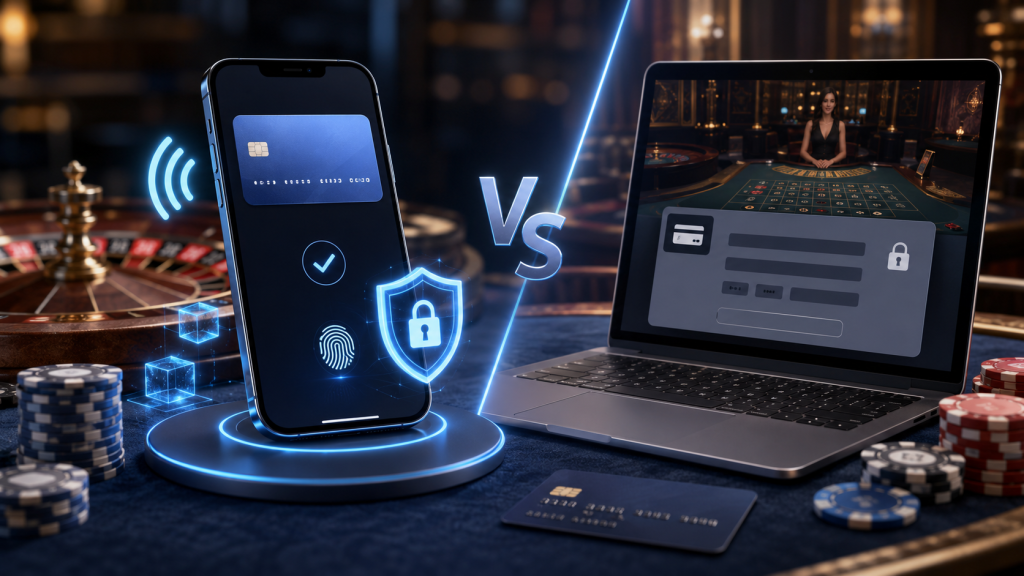
The Apple Pay vs credit card casino comparison depends on how the credit card is used. A direct credit card deposit asks the player to trust the casino cashier, payment gateway, browser environment, and saved payment settings. Apple Pay adds device authentication and tokenized payment credentials to that chain.
There is also a regulatory factor. In some markets, credit cards are restricted or prohibited for gambling because they allow players to gamble with borrowed money. In Great Britain, for example, credit card gambling was banned in 2020, including credit card payments through e-wallets. That does not mean Apple Pay is universally allowed or forbidden. It means the underlying card and local gambling rules still matter.
For players, the practical lesson is clear: Apple Pay casino payments safety depends not only on Apple Pay itself, but also on whether the casino accepts the method legally in the player’s jurisdiction and whether the linked card is permitted for gambling.
Apple Pay vs Debit Card Casino Payments
The Apple Pay vs debit card casino comparison is slightly different. Debit cards draw from existing funds, which makes them more common for gambling deposits in regulated markets. A direct debit card payment can be safe when the casino is reputable and the payment processor follows strong standards. Apple Pay can still add a security advantage by reducing direct card exposure and requiring biometric or passcode approval.
| Payment factor | Apple Pay casino payments | Direct debit or credit card deposits |
|---|---|---|
| Card details entered at casino | Usually not entered manually | Often entered directly |
| Authentication | Face ID, Touch ID, Optic ID, or passcode | Card details, 3D Secure, bank checks |
| Data exposure | Uses tokenized credentials | Card data may pass through more visible fields |
| Speed | Usually fast for deposits | Usually fast, but more manual steps |
| Withdrawal support | Often limited or unavailable | More commonly supported, depending on casino |
| Local restrictions | Depends on linked card and jurisdiction | Depends on card type and jurisdiction |
The table shows the main trade-off. Apple Pay is often safer and smoother for deposits, but direct cards may still be more widely supported for withdrawals. A player should never assume that the same method used for depositing will also be available for cashing out.
Mobile Wallet Security and Player Control
Mobile wallet security also improves the player’s control over the transaction. Apple Pay usually requires a physical device and a biometric or passcode confirmation. That creates a stronger barrier than a card number stored in a browser or entered on a shared device.
There is another benefit: fewer visible details. A player using Apple Pay does not have to expose their full card number on the casino screen. This is useful on mobile, where deposits may happen in public spaces or on smaller screens. It also reduces the chance of manual input errors.
Still, Apple Pay gambling payments are not immune to poor habits. A player who uses an unlicensed casino, ignores bonus terms, disables account security, or shares device access can still face problems. Apple Pay improves payment safety, but it does not make every Apple Pay online casino trustworthy.
What Apple Pay Does Not Protect
Apple Pay protects the payment process, not the entire gambling experience. A secure deposit can still lead to problems if the casino has unclear withdrawal rules, weak customer support, unfair bonus terms, or poor complaint handling.
Players should check:
- Whether the casino is licensed and available in their country
- Whether Apple Pay is supported for deposits only or also withdrawals
- Whether the linked card is allowed for gambling
- Deposit limits, fees, and minimum transaction amounts
- KYC requirements before the first withdrawal
- Bonus terms linked to Apple Pay deposits
- Responsible gambling tools such as deposit limits and self-exclusion
This is where payment security and casino reliability meet. A safe payment method is valuable, but only when paired with a legitimate operator and clear terms.
Why Casino Payment Safety Is Broader Than the Wallet
Casino payment safety includes more than encryption or tokenization. It also includes customer account records, withdrawal handling, complaint routes, and protection of player funds. Regulatory standards for remote gambling often require operators to provide access to account and transaction history, including deposits, withdrawals, movement of funds, bets placed, results, and winnings paid. That type of customer account information is part of a safer gambling environment.
Withdrawal rules are also important. Some regulators have warned that withdrawal delays and restrictions can affect whether gambling is conducted in a fair and open way. In practical terms, an Apple Pay deposit may be instant, but a withdrawal can still be delayed by KYC checks, method limitations, manual review, or operator policies. Guidance on account withdrawals shows why payment speed should be judged across the whole customer journey, not only at deposit.
Are Apple Pay Casino Payments Safer Than Cards?
Apple Pay casino payments are usually safer than entering card details directly because they combine device authentication, tokenized payment credentials, and a smoother mobile checkout. They can reduce the exposure of card information and make accidental or unauthorised payments harder than a basic card form.
Yet Apple Pay is not a substitute for due diligence. Apple Pay casino payments safety depends on the casino’s licence, payment processor, KYC rules, withdrawal policy, and responsible gambling standards. It is safer at the payment layer, but players still need to check the operator layer.
For most mobile-first players, the practical advantage is clear. Apple Pay can make casino deposits faster and more secure than manual card entry. The strongest approach is to use it only at reputable casinos, check whether withdrawals are supported, and treat payment security as one part of a wider safety review.